Ischemic Heart Disease and the Epidemiologic Transition: Progress without Reduction in Global Burden
DISCOVERIES (ISSN 2359-7232), 2026, Volume 14, Issue 1
REVIEW ARTICLE
FULL text (PDF)
CITATION: Nájera-Segura NS, Mora Guzmán Z, Moreno-Cabral S, Serrano Ortega MM, Zárate Ortiz C, Pérez-Campos Mayoral L, Jarquín González EE, Barreto G, Pérez-Campos E, Cabrera-Fuentes HA, Hernández-Huerta MT, Serebruany V. Ischemic Heart Disease and the Epidemiologic Transition: Progress without Reduction in Global Burden. Discoveries 2026, 14(1): e226. DOI: 10.15190/d.2026.5
Ischemic Heart Disease and the Epidemiologic Transition: Progress without Reduction in Global Burden
Nahui Samanta Nájera-Segura1,2, #, Zoila Mora Guzmán1, #, Sonia Moreno-Cabral3, María Magdalena Serrano Ortega3, César Zárate Ortiz4, Laura Pérez-Campos Mayoral1, Efrén Emmanuel Jarquín González5, Guillermo Barreto6, Eduardo Pérez-Campos7, Hector Alejandro Cabrera-Fuentes1,2,3, ^, *, María Teresa Hernández-Huerta1,8, ^, *, Victor Serebruany9,10, ^
- 1 Centro de Investigación Facultad de Medicina UNAM-UABJO, Facultad de Medicina y Cirugía, Universidad Autónoma "Benito Juárez" de Oaxaca (UABJO), Oaxaca, México 2 División de Estudios de Posgrado e Investigación, Tecnológico Nacional de México, Instituto Tecnológico del Valle de Etla, Santiago Suchilquitongo, Oaxaca, México 3 División de Estudios de Posgrado e Investigación, Tecnológico Nacional de México / Instituto Tecnológico de Tijuana, Tijuana, Baja California, México 4 Laboratorio de Bioquímica de Proteínas y Glicopatologías, Facultad de Odontología, Universidad Autónoma Benito Juárez de Oaxaca (UABJO), Oaxaca, México 5 Dirección General de los Servicios de Salud de Oaxaca, Secretaria de Salud, Servicios de Salud de Oaxaca, Oaxaca, Mexico 6 Université de Lorraine, CNRS, Laboratoire IMoPA, UMR 7365, Nancy, France 7 División de Estudios de Posgrado e Investigación, Tecnológico Nacional de México / Instituto Tecnológico Oaxaca, Oaxaca, México 8 SECIHTI, Facultad de Medicina y Cirugía, Universidad Autónoma "Benito Juárez" de Oaxaca (UABJO), Oaxaca, Mexico 9 HeartDrug Research LLC, West Friendship, MD, USA 10 Department of Neurology, Johns Hopkins University School of Medicine, Baltimore, MD, USA # These authors contributed equally to this work as co-first authors. ^ Equal contributors to this work as senior authors.
* Corresponding authors: Hector Alejandro Cabrera-Fuentes, PhD, Tecnológico Nacional de México / Instituto Tecnológico de Tijuana, División de Estudios de Posgrado e Investigación, Calz del Tecnológico 12950, Tomas Aquino, 22414 Tijuana, B.C, México; Email: hector.cf@tectijuana.edu.mx and María Teresa Hernández-Huerta, PhD, SECIHTI, Facultad de Medicina y Cirugía, Universidad Autónoma "Benito Juárez" de Oaxaca (UABJO), Oaxaca 68020, Mexico; Email: mthernandez@secihti.mx
Abstract
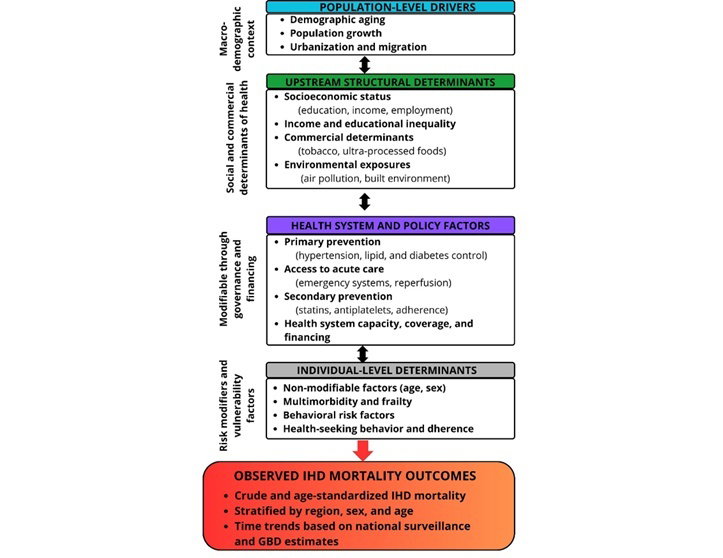
Ischemic heart disease (IHD) remains the leading cause of cardiovascular mortality worldwide. Although age standardized death rates have declined over the past two decades, the absolute number of deaths continues to rise due to population growth and demographic aging. This Perspective examines the resulting paradox of progress, in which improving mortality rates coexist with an expanding global burden. Emerging evidence from recent global analyses highlights widening disparities across regions, sexes, and age groups. Global Burden of Disease (GBD) studies suggest an increasing burden of early onset IHD among adults aged 15 to 49 years, associated with rising incidence and prevalence, with notable regional variability and links to metabolic and dietary risks. While high income settings continue to achieve sustained mortality reductions, low- and middle-income regions face persistent gaps in prevention and care. These disparities reflect differences in health system capacity, including limited screening, delayed access to acute cardiac care, and suboptimal use of secondary prevention. Scalable strategies such as task-sharing and simplified treatment approaches offer practical solutions but remain underused. A strategic shift toward implementation, life-course prevention, and equity-focused policy reform is essential. Importantly, this perspective bridges the gap between epidemiological trends and health policy, linking epidemiologic trends to scalable implementation strategies for clinicians and policymakers to address the global burden of IHD.