Responsible Innovation in AI-Driven Teledentistry: Ethical, Legal, and Economic Considerations for the Globalization Era
DISCOVERIES (ISSN 2359-7232), 2026, Volume 14, Issue 1
REVIEW ARTICLE
FULL text (PDF)
CITATION: Kaushik R, Rapaka R. Responsible Innovation in AI-Driven Teledentistry: Ethical, Legal, and Economic Considerations for the Globalization Era. Discoveries 2026, 14(1): e224. DOI: 10.15190/d.2026.3
Responsible Innovation in AI-Driven Teledentistry: Ethical, Legal, and Economic Considerations for the Globalization Era
Richa Kaushik 1,*, Ravindra Rapaka 2
- 1 School of Family Medicine and Public Health Sciences, Wayne State University, Detroit, USA
- 2 University of Connecticut, Storrs, CT, USA
* Corresponding authors: Richa Kaushik, Department of Family Medicine and Public Health Sciences Detroit, Detroit, MI, USA; Email: richakaushik@wayne.edu
Abstract
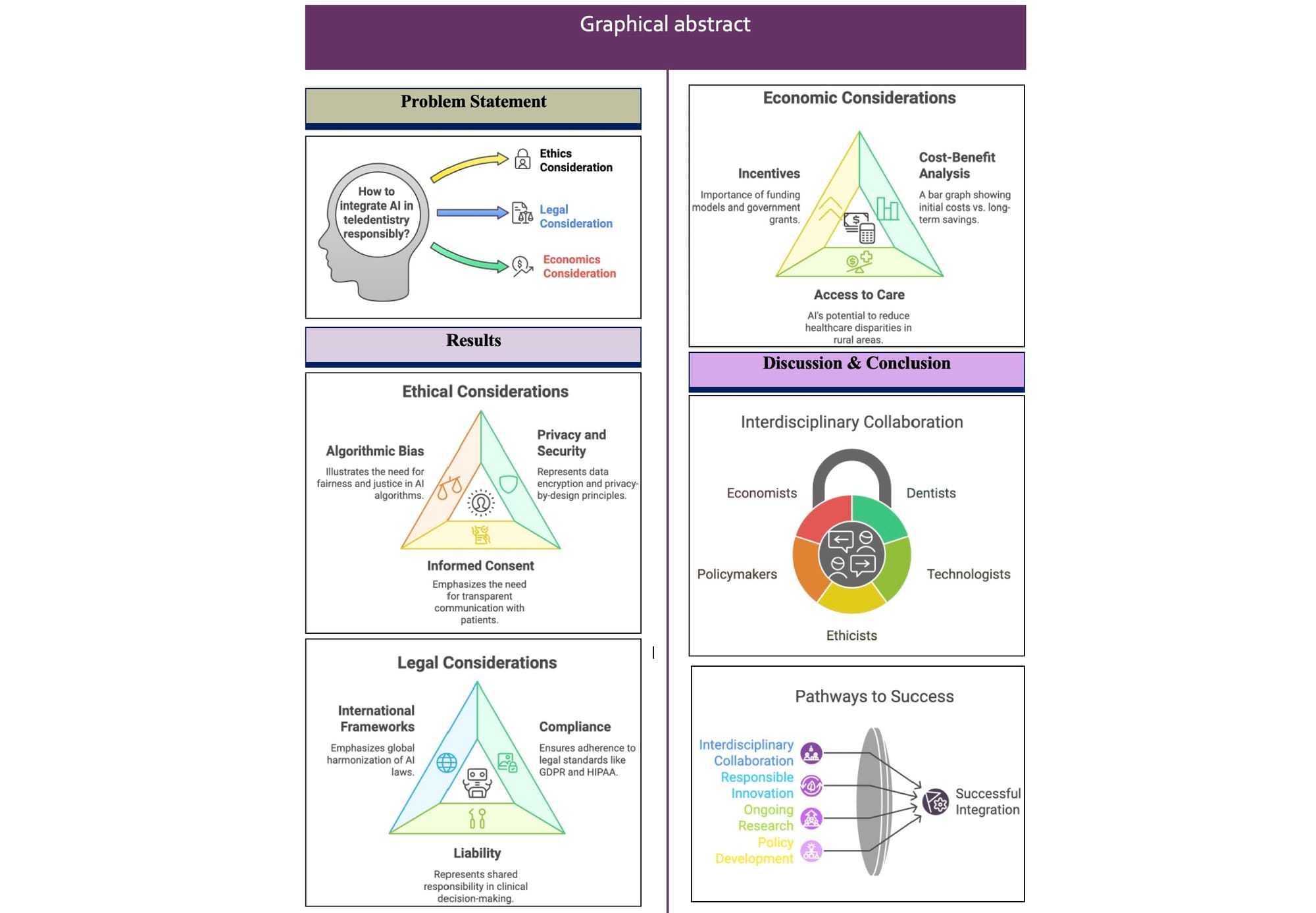
Teledentistry has evolved from asynchronous communication to real-time consultations, with adoption accelerating during and post-COVID. Concurrently, AI has been leveraged to enhance diagnostic accuracy, efficiency, and accessibility using machine learning, GANs, and connected devices. This scoping review, conducted using Arksey and O’Malley framework and Joanna Briggs Institute guidance, explores the ethical, legal, and economic considerations of AI-driven teledentistry. Following a PRISMA-ScR compliant screening process by two independent reviewers, 137 studies published between 2018 and 2025 were included. Unlike previous reviews that have primarily focused on clinical applications or the general use of AI in healthcare, this review addresses the ethical, legal, and economic considerations of AI in teledentistry in a single paper. It underscores the importance of explainable AI, explores cross-border regulatory challenges, and discusses possible cost models for adoption in smaller practices. This review indicates that AI-powered teledentistry could enhance diagnostic accuracy, facilitate early detection, improve monitoring, and increase accessibility. Nonetheless, these advantages come with critical concerns including data privacy, potential biases, patient autonomy, accountability, and cost. Addressing these issues through governance, oversight, transparency, and economic viability is essential. AI-enabled teledentistry has the potential to transform dental care delivery, but its integration must be approached with careful consideration of its associated challenges.